

As an ENT and cochlear implant surgeon, I have lost count of the number of patients who come to me after months, sometimes years, of being treated for “just another ear infection.” This is why understanding cholesteatoma symptoms and treatment is so important. A persistent, foul smelling discharge that never fully clears. A dulling of hearing that gets brushed off as wax buildup.
These are easy signs to dismiss, and that is exactly what makes cholesteatoma so dangerous. It hides behind a familiar diagnosis while quietly damaging the delicate structures of the ear. In this post, I explain what cholesteatoma is, why it is so often missed early, how it is treated surgically, and what monitoring looks like afterward, so you know exactly what to watch for and when to ask for a closer look.
What Is a Cholesteatoma, in Simple Terms?
A cholesteatoma is an abnormal skin growth that forms behind the eardrum, usually as a result of repeated infections or a pocket of eardrum tissue that has retracted inward over time. Left alone, it slowly enlarges and can erode the small bones and structures of the middle ear. This matters because untreated cholesteatoma can lead to permanent hearing loss, balance problems, facial nerve involvement, and in rare cases, spread toward the brain. The sections below walk through why it is so often missed, how it is diagnosed, and what treatment and recovery actually involve.
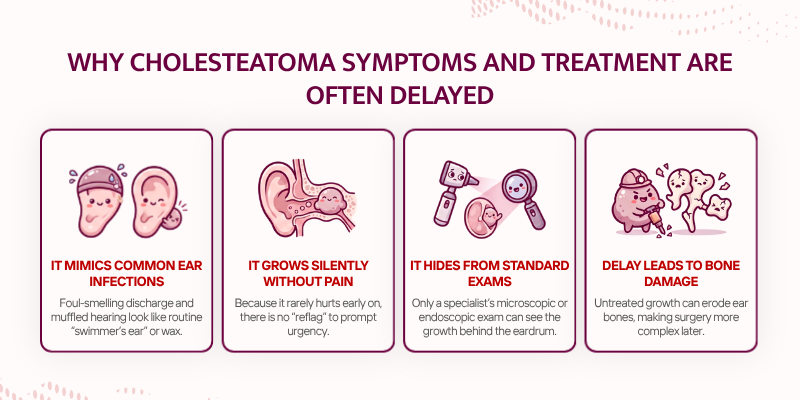
Why Cholesteatoma Symptoms and Treatment Are Often Delayed
One of the biggest challenges with cholesteatoma symptoms and treatment is timing. I recently treated a young patient who had been managed for “recurring ear infections” for over a year before an examination finally revealed a cholesteatoma. This kind of delay is common, and it is rarely due to negligence on the part of parents or patients.
The reason is simple: cholesteatoma symptoms overlap heavily with ordinary otitis media. Ear discharge, mild hearing loss, and occasional discomfort look identical to a routine infection on the surface. Early cholesteatoma can also be painless, which means there is often no red flag urgent enough to prompt a deeper look. Without a proper microscopic or endoscopic ear examination, the underlying growth can continue silently for months. This is precisely why any ear infection that keeps returning despite treatment deserves a specialist evaluation, not just another course of ear drops.
Recognizing the Signs Before Hearing Is Affected
Beyond recurring discharge, cholesteatoma often shows up through subtler cues that are easy to overlook. I once evaluated an adult patient who had noticed a gradual dulling of hearing in one ear along with occasional bouts of dizziness. Neither symptom felt urgent on its own, so both were dismissed for months before a CT scan confirmed the diagnosis.
I want to be clear that this kind of delay is understandable, not a failure on the patient’s part. These signs are genuinely easy to miss. What helps is knowing that a combination of hearing loss, ear discharge, a sensation of fullness, or balance disturbance, especially alongside a history of frequent ear infections, warrants a proper otoscopic or microscopic examination. In many cases, a high resolution CT scan of the temporal bone is used alongside the clinical exam to confirm the extent of the growth and plan next steps with confidence rather than guesswork.
How Cholesteatoma Symptoms and Treatment Are Managed Surgically
The good news is that cholesteatoma symptoms and treatment have well established surgical solutions with generally strong outcomes. The standard approach is a mastoidectomy, sometimes combined with tympanoplasty, to fully remove the abnormal growth and reconstruct the affected middle ear structures. According to established otology literature, complete surgical removal is essential because any residual tissue can regrow over time, which is why thorough clearance during the initial surgery matters so much.
The exact surgical technique depends on how extensive the disease is and the individual anatomy of the ear. In many cases, hearing can be preserved or meaningfully restored as part of the same procedure or a planned second stage. What I want every patient to know is that a cholesteatoma diagnosis is not a crisis, it is a clearly treatable condition, and the earlier it is caught, the more straightforward the surgical plan tends to be.
Dr. Shree Rao's Clinical Approach to Cholesteatoma Care
Whenever a patient comes to me with a persistent or recurring ear issue, I make it a practice to look closely with a microscope or endoscope before simply treating it as another infection. Cholesteatoma can hide behind ordinary symptoms, and I would rather rule it out early than have a patient return months later with more extensive disease.
Every case I see is staged individually. I look at how far the growth has progressed, the anatomy of the ear canal and mastoid, and the patient’s hearing status before recommending a surgical plan. No two ears are identical, and no two treatment plans should be either.
I also encourage patients and parents to be active participants in this process. If an ear infection keeps coming back despite treatment, it is completely reasonable to ask your doctor directly whether cholesteatoma has been considered. This kind of awareness is part of what drives our larger #DeafFreeIndia mission, preventing hearing loss that could have been avoided with earlier evaluation.
Have a Persistent Ear Issue That Will Not Clear Up?
If you or your child have been dealing with recurring ear discharge, unexplained hearing changes, or an infection that never seems to fully resolve, it is worth getting a specialist evaluation rather than waiting it out. You can book an appointment directly at earsurgeon.in/book-an-appointment. To understand how cholesteatoma differs from more common conditions, take a look at our guide on fluid behind the eardrum, glue ear versus ear infection. For more ear health awareness content, follow Dr. Shree Rao on Instagram and YouTube.
FAQs
What are the early cholesteatoma symptoms?
Early cholesteatoma symptoms include persistent or foul-smelling ear discharge, gradual hearing loss, a feeling of fullness in the ear, and occasional dizziness. These symptoms can resemble a routine ear infection, making early diagnosis difficult.
How is cholesteatoma diagnosed?
Cholesteatoma is diagnosed through a detailed ear examination using an otoscope, microscope, or endoscope. Your ENT specialist may also recommend a high-resolution CT scan of the temporal bone to determine the size and extent of the disease.
What is the best treatment for cholesteatoma?
The primary treatment for cholesteatoma is surgery. Procedures such as mastoidectomy, often combined with tympanoplasty, are performed to remove the abnormal skin growth and preserve or restore hearing whenever possible.
Can cholesteatoma cause permanent hearing loss?
Yes. If left untreated, cholesteatoma can damage the tiny hearing bones in the middle ear, leading to permanent hearing loss. Early diagnosis and timely treatment significantly reduce this risk.
Is cholesteatoma surgery successful?
Yes. Cholesteatoma surgery has a high success rate when performed by an experienced ENT surgeon. Regular follow-up appointments are important because the condition can recur in some patients.
When should I see an ENT specialist for cholesteatoma symptoms?
You should consult an ENT specialist if you have recurring ear infections, persistent ear discharge, hearing loss, dizziness, or ear symptoms that do not improve with treatment. Early evaluation helps prevent serious complications.