

When your child is diagnosed with hearing loss, one of the first questions many parents ask is, “How did this happen? Neither my spouse nor I have hearing problems.” If genetic testing identifies a change in the GJB2 gene and childhood hearing loss, this can provide an important part of the answer. But the word “gene” can sound complicated and frightening. In simple terms, the GJB2 gene contains instructions that help the inner ear function properly. Changes in this gene can cause hearing loss, sometimes from birth.
What is the GJB2 gene?
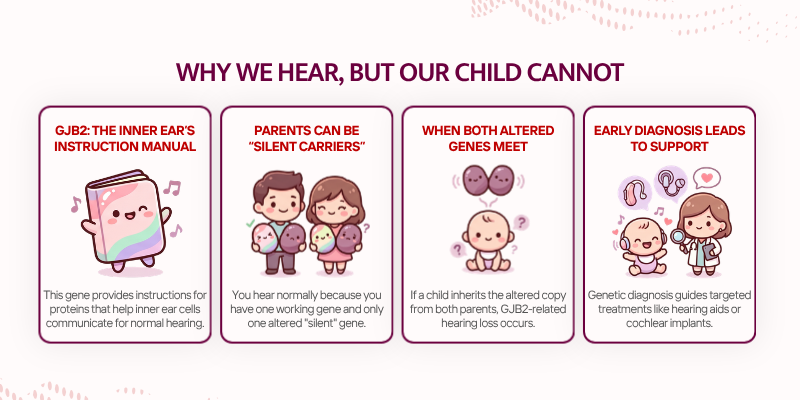
Think of genes as instruction manuals inside our cells. The GJB2 gene provides instructions for making a protein called connexin 26. This protein helps cells in the inner ear communicate with one another and maintain the environment needed for hearing.
When certain changes occur in both copies of the GJB2 gene, the inner ear may not function normally. This can result in sensorineural hearing loss, which means the problem is in the inner ear rather than the ear canal or middle ear.
GJB2-related hearing loss is one of the more common genetic causes of congenital, or present-from-birth, hearing loss. The degree of hearing loss can vary from mild to profound.
How can my child have GJB2-related hearing loss if we both hear normally?
This is perhaps the most important thing for parents to understand.
GJB2-related hearing loss commonly follows what is called autosomal recessive inheritance. A child receives two copies of most genes, one from each parent. If both parents carry one altered copy of GJB2, they can have completely normal hearing because their other copy works normally.
If a child inherits the altered copy from both parents, however, the child can develop GJB2-related hearing loss.
This is why there may be no previous history of deafness in the family. Parents may be healthy carriers without knowing it.
Importantly, this does not mean either parent “caused” the child’s hearing loss. Genetic changes can remain unnoticed through generations until two carriers have a child together.
Does a GJB2 mutation always cause profound deafness?
No. Not every GJB2 change has the same effect.
Some variants are associated with severe or profound hearing loss, while others may cause milder hearing loss. In some children, hearing loss can also change over time. This is why the specific genetic variant identified in a child’s test matters, rather than simply knowing that “GJB2 is positive.”
A genetic result should therefore be interpreted alongside hearing tests, clinical examination and, when appropriate, other investigations.
What does a GJB2 diagnosis mean for treatment?
Finding a GJB2-related cause does not itself determine the treatment. The child’s degree and type of hearing loss, hearing-aid benefit, age, developmental stage and overall assessment all matter.
For children with significant hearing loss, early identification and appropriate intervention are important. Depending on the level of hearing loss, treatment may involve hearing aids, speech and language support, or cochlear implantation.
Research has also found that children with GJB2-related hearing loss can achieve good outcomes following cochlear implantation when they are appropriate candidates.
Parents exploring cochlear implants can learn more about the procedure and rehabilitation through cochlear implant care.
What should parents do after a GJB2 result?
A genetic report can contain unfamiliar terms such as “variant,” “pathogenic,” “carrier,” or “uncertain significance.” These words should not be interpreted without professional guidance.
The next step is to understand exactly what variant was identified, whether one or both copies of the gene are affected, and how the result fits with the child’s hearing tests.
Genetic counselling can also help parents understand what the result may mean for future pregnancies and other family members.
For parents navigating a child’s hearing loss, the most important message is that a genetic diagnosis is not the end of the journey. It can help explain why the hearing loss occurred and, in appropriate cases, support decisions about early hearing intervention.
Conclusion
A change in the GJB2 gene is a genetic explanation for hearing loss in many children, and it can occur even when both parents have completely normal hearing. Understanding how recessive inheritance works can remove much of the confusion and guilt parents may feel after receiving a diagnosis.
If your child has been diagnosed with GJB2-related hearing loss, discussing the genetic result alongside the child’s hearing assessment can help determine the appropriate next steps. If you are seeking specialist guidance, you can book an appointment to discuss your child’s hearing and available treatment options.
FAQs
My spouse and I are not deaf. Why is my child deaf?
Both parents can carry one altered copy of the GJB2 gene without having hearing loss themselves. If the child inherits an altered copy from both parents, GJB2-related hearing loss can occur. This is a common pattern for recessive genetic conditions.
Does having a GJB2 mutation mean my next child will also be deaf?
Not necessarily. If both parents are carriers of the same recessive condition, each pregnancy has an independent chance of inheriting both altered copies. A genetic counsellor can explain the specific recurrence risk based on your child’s genetic report.
Can a child with GJB2 hearing loss hear with hearing aids?
It depends on the severity of hearing loss and how much benefit the child receives from appropriately fitted hearing aids. Children with severe or profound hearing loss may be evaluated for cochlear implantation.
Does GJB2-related hearing loss affect intelligence or development?
GJB2-related hearing loss is generally described as nonsyndromic, meaning the hearing loss occurs without other associated medical features. However, every child should be assessed individually, particularly when developmental concerns are present.
When should we see a specialist after receiving a GJB2 result?
Parents should discuss the genetic result with an appropriate hearing-care team rather than interpreting the report alone. A specialist can review the genetic findings alongside hearing tests and discuss options. Families looking for a best cochlear implant specialist in Hyderabad may also consider the team’s experience with pediatric hearing loss and cochlear implantation.
How is the GJB2 genetic test performed?
The GJB2 test is usually performed using a small sample of blood or saliva. The sample is sent to a genetic laboratory, where the laboratory examines the GJB2 gene for specific changes that may be associated with hearing loss. It does not require any procedure involving the ear.
The results may identify whether a child has one or two altered copies of the gene and, depending on the test, the specific genetic variant involved. A doctor or genetic counsellor should interpret the report because not every genetic change causes hearing loss, and some results may require additional testing or interpretation.
For parents, the test can provide useful information about the possible cause of their child’s hearing loss and may also help with understanding inheritance and future family planning.
Is GJB2 genetic testing available in India?
Yes. GJB2 testing is available in India through genetic laboratories and specialist centres. For example, the Centre for Cellular and Molecular Biology (CCMB) lists a GJB2 mutation analysis test for nonsyndromic hearing loss, using a blood sample. Indian genetic testing directories also list laboratories offering GJB2 and GJB6 testing.
Depending on the child’s hearing-loss history, the doctor may recommend testing GJB2 alone or as part of a broader genetic hearing-loss panel that looks at several genes. It is useful to discuss the appropriate test with the child’s ENT specialist or a genetic counsellor rather than ordering a test based only on the name “GJB2.”
The availability, cost, testing method and turnaround time can vary between laboratories.
Can expecting parents get genetic testing before having a baby?
Yes. Couples can undergo genetic carrier screening before pregnancy to identify whether they carry certain inherited conditions. If there is a family history of hearing loss or a known GJB2 variant in the family, a doctor or genetic counsellor may recommend targeted GJB2 testing. Broader carrier screening panels may also be considered. Preconception testing gives couples an opportunity to understand their genetic risks before pregnancy and discuss available options.