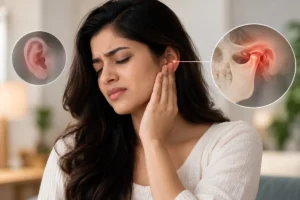

Many of my patients arrive already having visited several specialists, undergone hearing tests, and been told multiple times that nothing is wrong with their ears. Yet they suffer from recurring episodes of dizziness and have a poor quality of life.
If this sounds like you, vestibular migraine may be what you are experiencing. Vestibular migraine is a neurological condition in which the brain’s migraine pathways produce episodes of dizziness, spinning, or unsteadiness, sometimes with little or no headache at all. Because the symptom that stands out is dizziness rather than head pain, it is one of the most underdiagnosed causes of recurring vertigo in adults, and it is more common than many people realise.
What Vestibular Migraine Is and Why It Is Frequently Missed
A Migraine That Targets Balance, Not Always Pain
Migraine is far more than a severe headache. It is a complex neurological disorder in which the brain becomes hypersensitive to stimulation and generates abnormal signals. In vestibular migraine, these abnormal signals affect the part of the brain that processes balance and spatial orientation, which is why dizziness or vertigo becomes the dominant experience.
Why Diagnosis Is So Often Delayed
The condition is missed for several reasons. First, many patients with vestibular migraine do not have prominent headaches during their dizzy episodes, so neither the patient nor their initial doctor connects the problem to migraine. Second, standard ear tests such as audiograms and tympanograms return normal results, misleading the patients into believing that the ears are fine without exploring neurological causes. Third, awareness of vestibular migraine among general practitioners and even some specialists remains lower than awareness of more familiar conditions like BPPV or Meniere’s disease. For patients who have lived with unexplained dizziness for years, finally understanding what is happening can itself be a significant relief.
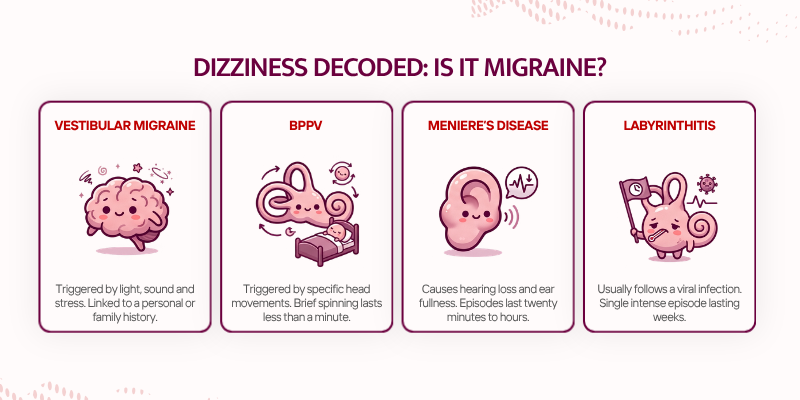
How Vestibular Migraine Symptoms Differ from BPPV, Meniere's, and Labyrinthitis
For patients who have lived with unexplained dizziness for years, finally understanding what is causing their symptoms can be life-changing.
Feature | Vestibular Migraine | BPPV | Meniere’s Disease | Labyrinthitis |
Duration | Minutes to several hours; mild imbalance may linger for days | Under a minute per episode | 20 minutes to several hours | Single prolonged episode, resolves over weeks |
Trigger | Not position dependent | Specific head movements (rolling over, looking up) | Not consistently triggered | Usually viral infection |
Hearing changes | Typically none, non-progressive | None | Yes, with aural fullness | Can occur (infection related) |
Light/sound sensitivity | Common (photophobia, phonophobia) | Not typical | Not typical | Not typical |
Visual aura | Common, before or during episode | Absent | Absent | Absent |
Motion sensitivity | Worse in cars, crowded/visual environments | Not a defining feature | Not a defining feature | Not a defining feature |
Migraine history | Often personal or family history | Not relevant | Not relevant | Not relevant |
Triggers: Sleep, Screens, Caffeine, Hormones, and Stress
Common Triggers That Patients Often Overlook
- Sleep: too little, too much, or irregular timing; erratic work hours and long commutes in India often disrupt patterns
- Screens: extended phone/computer use in low light or with bright blue-toned displays can prime the migraine brain
- Caffeine: regular intake can mask threshold; sudden reduction or excess can trigger episodes
- Food: aged cheeses, fermented items, and MSG-heavy Indian processed snacks are common culprits
- Alcohol: red wine and beer are frequently documented triggers
- Hormones: menstrual fluctuations often cause episodes to cluster at predictable cycle points
- Stress: both active stress and the let-down phase after it can provoke attacks
- Tracking: a symptom diary logging sleep, food, stress, and cycle phase helps identify personal patterns
Diagnosis by Exclusion and Long-Term Management Strategies
How Vestibular Migraine Is Diagnosed
There is no single test that confirms vestibular migraine. Diagnosis relies on a careful clinical assessment that rules out inner ear conditions, cardiovascular causes, and other neurological disorders before concluding that migraine is the most likely explanation. Audiological testing, vestibular function tests, and sometimes imaging may be ordered to exclude other causes.
The diagnostic criteria established by the International Headache Society require a history of at least five episodes of vestibular symptoms of moderate or severe intensity, a current or prior diagnosis of migraine, and migraine-related features accompanying at least half of the episodes, such as head pain, light sensitivity, or visual aura. Meeting these criteria and eliminating alternative diagnoses is essential for the diagnosis of Vestibular Migraine.
Long-Term Management: Lifestyle, Medication, and Vestibular Rehabilitation
Management of vestibular migraine focuses on reducing frequency and severity rather than curing the underlying tendency.
- Lifestyle regularity: Consistent sleep and wake times, regular meals, and good hydration.
Limiting dietary triggers and managing screen time also reduce attack frequency. - Low risk changes: These adjustments carry minimal risk and side effects.
Noticeable benefits are often seen within just a few weeks. - Acute medications: Taken during an episode to reduce its severity.
Used as needed rather than on a daily schedule. - Preventive medications: Taken daily to lower attack frequency over time.
Includes certain antidepressants, beta-blockers, and anti-epileptic drugs. - Specialist monitoring: These medications require prescription and monitoring.
A neurologist or ENT specialist experienced in migraine disorders should oversee treatment. - Vestibular rehabilitation: Delivered by a trained physiotherapist to aid adaptation.
Helps reduce the sensation of dizziness between episodes. - Cochlear implant patients: Those with prior implantation need careful management.
Vestibular migraine control matters for overall hearing and balance health.
Moving Forward
Vestibular migraine symptoms can be disorienting and distressing, particularly when they arrive without an obvious cause and persist despite normal ear tests. The good news is that once correctly identified, the condition responds well to a combination of lifestyle adjustments, trigger management, and medication when needed.
If you have been experiencing recurring dizziness with or without headache, and investigations of your ears have not provided answers, a thorough assessment for vestibular migraine may finally give you the explanation you have been looking for. To discuss your symptoms and explore a management plan suited to your situation, you are welcome to book an appointment with Dr. Shree Rao.
FAQs
Can vestibular migraine occur without any headache at all?
Yes, this is common and one reason the condition is often missed. Many patients experience dizziness with only mild pressure or no head pain at all. Diagnosis relies on the overall symptom pattern, associated features like light sensitivity, and ruling out other causes, not on headache being present.
How is vestibular migraine treated differently from other causes of vertigo?
Treatment depends entirely on the underlying cause. BPPV needs repositioning manoeuvres, infections need rest and anti-vertigo medication, but vestibular migraine needs trigger management, lifestyle regularity, and often preventive medication. A repositioning manoeuvre does nothing for migraine, and migraine medication does nothing for displaced ear crystals, so accurate diagnosis matters before treatment starts.
When should I see a specialist rather than managing symptoms on my own?
See a specialist if episodes are frequent, affect work or driving, or have not improved with lifestyle changes. A best ENT specialist in Hyderabad with experience in vestibular conditions can assess, investigate, and coordinate care with a neurologist where needed. Early diagnosis saves time, anxiety, and unnecessary tests.