
The birth of a child is a momentous occasion, but for parents of babies who require care in the Neonatal Intensive Care Unit (NICU), it is also a time of heightened anxiety and complex medical decisions. Amidst the monitors and life-saving equipment, one specific screening often takes place that carries lifelong weight: the BERA Test for NICU Babies, also known as the Brainstem Evoked Response Audiometry (BERA) test. As an ENT surgeon specializing in otology and cochlear implants at EarSurgeon, I have seen firsthand how early detection via BERA can fundamentally shift a child’s developmental trajectory. While standard newborn hearing screening tests are common for all infants, for those who spend more than five days in the NICU, the BERA test is not just recommended; it is a clinical mandate. Understanding why this specific group of infants requires a more advanced diagnostic approach is the first step in safeguarding their future ability to hear, speak, and learn.
What is BERA?
BERA stands for Brainstem Evoked Response Audiometry. It is an objective hearing test that measures how the hearing nerve and the brain respond to sounds. Unlike traditional hearing tests where a person must raise their hand or speak when they hear a sound, the BERA does not require any response from the baby. This makes it the “gold standard” for testing newborns.
Many parents worry if the test is painful or intrusive for their fragile infant. I want to reassure you that it is completely non-invasive and painless. We simply place tiny sensors (electrodes) gently on the baby’s forehead and behind the ears. Small earphones are then placed in the ears to deliver clicking sounds or tones. The test is most successful when the baby is in a deep, natural sleep, so it is often scheduled around feeding times. There are no needles and no discomfort involved for your little one.
How does BERA testing help diagnose hearing in infants?
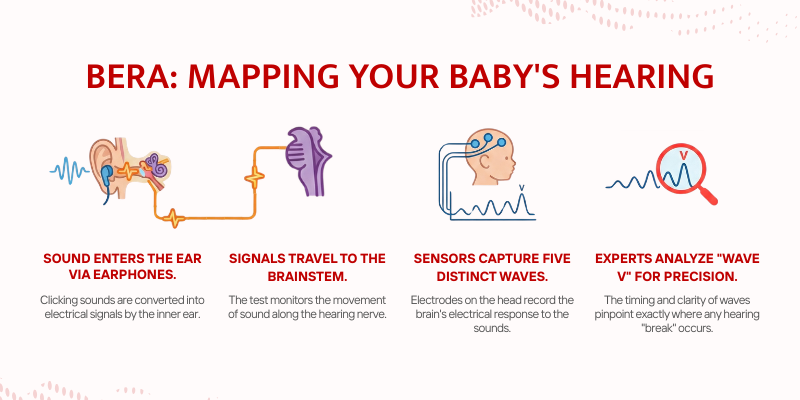
The BERA test provides a window into the entire auditory pathway. When the clicking sounds enter the ear, the inner ear (cochlea) converts those sounds into electrical signals. These signals then travel along the hearing nerve to the brainstem. The sensors on the baby’s head pick up this electrical activity and display it as five distinct waves on a monitor.
We look closely at these waves—specifically “Wave V.” We study the timing, the strength, and the clarity of these waves. If the waves are delayed or do not appear at all, it tells us exactly where the “break” in the communication is happening. This allows us to determine the degree of hearing loss with high precision, even in a baby only a few days old. Because it bypasses the need for the child to “behave” or respond, it gives us a clear, scientific map of their hearing health.
Why is BERA crucial for NICU babies?
For infants in the NICU, the risk of hearing loss is significantly higher, as supported by guidelines from the American Academy of Pediatrics. These babies often face challenges such as premature birth, low birth weight, severe jaundice, or the need for certain life-saving medications that can unfortunately be ototoxic. Ototoxic means that the medication, while necessary to save the baby’s life, may have the side effect of harming the delicate hair cells in the inner ear or the hearing nerve.
The BERA is particularly crucial here because standard screenings (like the OAE test) only check the inner ear. However, many NICU babies suffer from Auditory Neuropathy Spectrum Disorder (ANSD). This is a condition where the inner ear works fine but the sound is not transmitted properly from the ear to the brain. An OAE test would show a “pass,” giving parents a false sense of security, while the BERA would correctly identify the neural issue. For any baby staying in the NICU for more than five days, the BERA is the only way to ensure we aren’t missing a hidden hearing problem.
What should parents do if their baby fails the BERA test?
If your baby does not pass the initial BERA screening, do not panic, but do take immediate action. A “refer” or “fail” result does not always mean permanent deafness; sometimes fluid in the ear or debris from birth can interfere with the signals. However, we must follow the “1-3-6” rule: screening by 1 month, diagnosis by 3 months, and intervention by 6 months.
Your first step should be to book a pediatric hearing evaluation with a diagnostic BERA test. This is a more detailed version of the initial screening. If a hearing loss is confirmed, we will discuss a customized roadmap for your child. This may include medical management, high-quality hearing aids, or evaluating the child for cochlear implant surgery. The goal is to ensure your child has access to sound during the critical window of brain development so their speech and language can develop normally.
Conclusion
If your baby is currently in the NICU or has recently been discharged after a stay of five days or more, please ensure that a formal BERA Test for NICU Babies has been completed and explained to you. Do not wait for obvious signs of hearing trouble like a lack of response to loud noises or delayed babbling. Early detection is the greatest gift you can provide to a child with hearing loss. My team and I at EarSurgeon are dedicated to supporting you through every step of this journey, from the initial diagnostic waves to the life-changing moment a child hears their parent’s voice for the first time. Let us safeguard your child’s hearing before the window of early development closes.
If you have concerns about your child’s hearing screening results or would like to schedule a comprehensive evaluation, please get in touch.
FAQs
What is the BERA Test for NICU Babies?
The BERA Test for NICU Babies checks how the hearing nerve and brain respond to sound, helping detect early hearing loss.
Why is the BERA test important for NICU babies?
NICU babies have a higher risk of hearing problems. The BERA test detects both inner ear and nerve-related hearing issues.
Is the BERA test safe for newborns?
Yes, the BERA test is painless, non-invasive, and safe. It is usually done while the baby is sleeping.
What if my baby fails the BERA test?
A failed BERA test does not always mean permanent hearing loss. A detailed diagnostic test is needed for confirmation.