

When a child’s marks begin to slip, families usually look first at effort, sleep, or changes at home. Hearing loss school performance concerns rarely come to mind, yet they are among the most overlooked causes of classroom difficulty. A child who cannot clearly catch the teacher’s instructions may look distracted, careless, or slow. The problem is seldom a lack of ability. More often, the child lacks reliable access to sound. Understanding these links helps parents and teachers ask the right questions sooner.
How even mild or one-sided hearing loss affects learning
Many people assume hearing loss means profound deafness. In practice, a child with a mild or one-sided loss may miss soft consonants such as s, f, and t, which carry much of the meaning in spoken language. In a quiet room, the child may cope well enough. A busy classroom with ceiling fans, chatter, and echoing walls is a far harder listening environment, and the gap between what is said and what is heard widens quickly.
Research supports this concern. Bess, Dodd-Murphy, and Parker (1998) found that children with minimal sensorineural hearing loss were more likely to repeat a grade and to show lower academic performance than peers with normal hearing. Lieu (2013) reviewed evidence that children with unilateral hearing loss, where only one ear is affected, may also show weaker speech-language skills and school performance. A child with one working ear can seem to hear well in one-to-one conversation yet struggle during group work or when the teacher speaks from across the room.
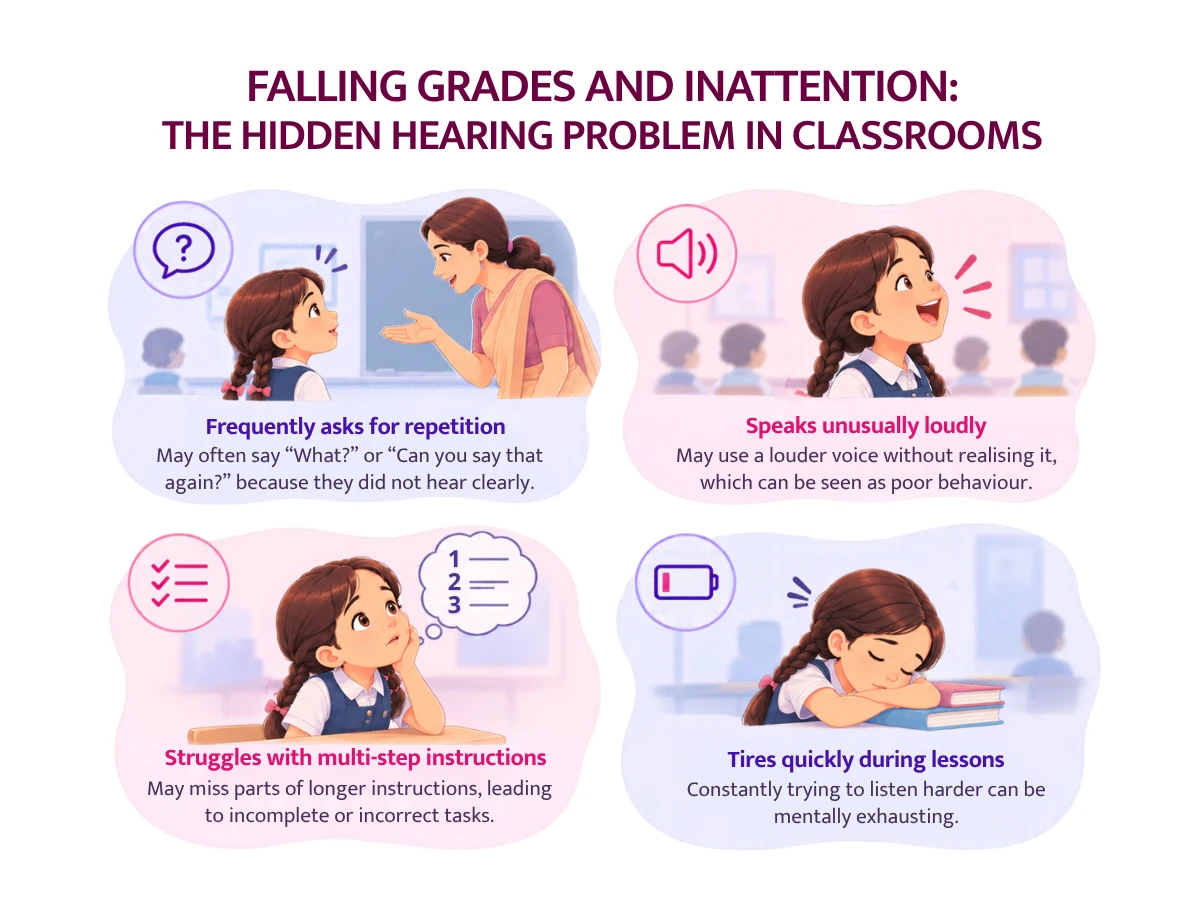
Classroom signs teachers and parents commonly mistake for behaviour issues
Hearing difficulties often present as behaviour rather than as a complaint about hearing, which is why they are frequently missed. A child may ask for instructions to be repeated, turn the head to bring one ear toward the speaker, or seem inattentive when addressed from behind. Some children speak unusually loudly, while others have speech that sounds flat or unclear. Difficulty following multi-step instructions, sitting unusually close to the board, and tiring quickly during lessons are also common. Reading and spelling may lag behind a child’s general ability. Teachers may describe these patterns as poor focus or low effort, and parents may begin to wonder about attention difficulties. Before any behavioural label is applied, a hearing assessment is a sensible first step. The child deserves to be heard before being judged.
Glue ear: the silent, treatable cause of fluctuating hearing in school children
Glue ear, known medically as otitis media with effusion, occurs when fluid collects in the middle ear behind an intact eardrum. Because the fluid is painless, children rarely complain, and the hearing loss tends to come and go. It is especially common in younger children and often follows a cold or an allergic flare. Clinical guidance from the American Academy of Otolaryngology–Head and Neck Surgery recommends a period of watchful waiting, typically around three months, because many cases resolve without intervention. That watchful waiting should be structured, with repeated hearing checks, so that persistent cases are identified early. For children whose fluid does not clear, options can include ventilation tubes, which allow air into the middle ear and help drain the fluid. Families who want to understand how pediatric hearing loss is evaluated and managed can read our guide on decoding pediatric hearing loss.
Testing, seating strategies, and working with the school
A school screening can flag a concern, but it cannot diagnose hearing loss. A full assessment usually includes pure tone audiometry for children old enough to respond reliably, with play-based testing for younger children, along with tympanometry to check middle ear function. Where needed, objective tests such as otoacoustic emissions or auditory brainstem response testing can be used. Once a loss is confirmed, practical classroom adjustments make a real difference. Seating a child near the front, away from fans, open windows, and corridors, brings the teacher’s voice closer and clearer.
Teachers can face the child when speaking, reduce background noise where possible, and pair spoken instructions with written or visual cues. Checking understanding by asking the child to repeat a task, rather than assuming it was heard, also helps. With parental consent, the audiology report can be shared with the class teacher so that a simple plan is agreed and reviewed at the end of each term. For children with a confirmed loss who are building spoken language, why auditory verbal therapy is critical explains how structured listening training supports learning. Parents who notice these patterns can arrange an assessment through the EarSurgeon appointment page.
FAQs
Can hearing loss really cause falling grades?
Yes, it can. Research links hearing loss school performance problems to missed instructions, reduced participation, and lower marks, even when the loss is mild or affects only one ear. Parents who notice persistent inattention, repeated requests for instructions, or a sudden drop in marks should request a hearing test early. Dr. Shree Rao’s practice provides pediatric ENT care for children with these concerns.
Is a school hearing screening enough?
A school screening is a useful first alert, but it is not a diagnosis. Screenings are often carried out in noisy rooms with limited equipment, so a child may pass on the day and still have a fluctuating loss, such as glue ear. If concerns remain after a pass, a full audiological assessment is the appropriate next step.
Can a child with one-sided hearing loss still do well at school?
Many children with one-sided hearing loss do well, particularly when the difficulty is identified early and the classroom is arranged to help. Good seating, a clear view of the teacher’s face, and reduced background noise can make a meaningful difference. Ongoing monitoring matters too, because a child’s needs can change as they move through school.
Conclusion
Falling grades and inattention are rarely just about effort. Hearing loss school performance problems are often identifiable and treatable when families and schools treat hearing as one of the first questions rather than the last. A timely check can restore a child’s access to the classroom and to their own potential.